

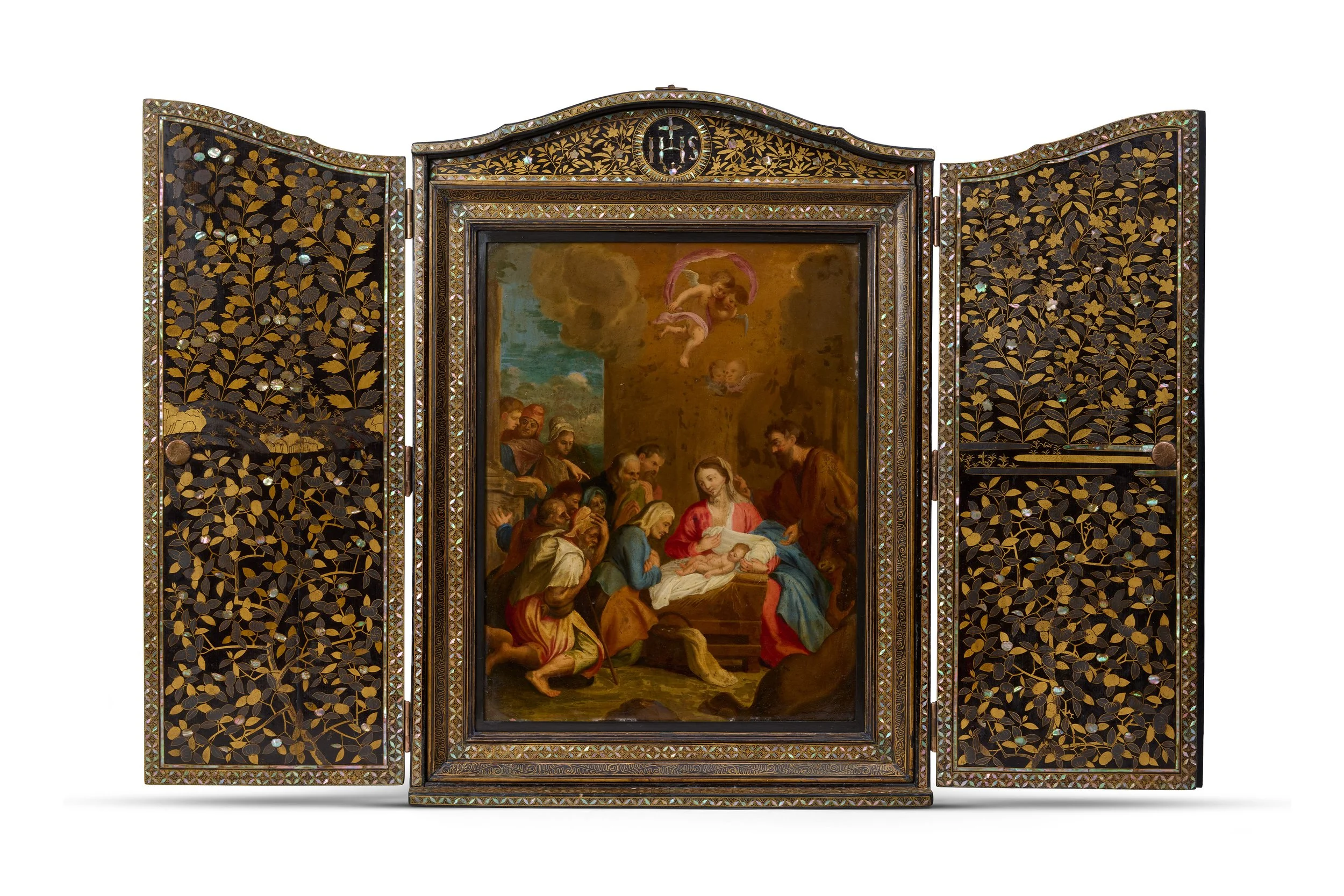
Oratory
Wood, lacquer, mother-of- pearl, gold and silver; gilded metal mounts; oil on copper
Japan – Momoyama period (1573–1615); Painting – Spanish School, 17th century
H. 69 cm L. 51 cm (102.5 cm open) W. 7.5 cm
Ref. 16510
The history of Christianity in Japan began in 1549, when the Jesuit missionary Francis Xavier arrived in Kagoshima on 15 August, bringing with him devotional paintings and objects intended to aid his mission. At the time, Japan was divided by civil conflict among regional daimyō. The Jesuits preached publicly, often displaying images of the Virgin or Christ, and initially sought converts among the elite before extending their efforts to wider society. By 1582, the Jesuits claimed some 150,000 converts, rising to approximately 320,000 by the early seventeenth century. Missionaries adopted structured instructional methods and increasingly relied on visual materials to communicate Christian doctrine.
Official opposition began in 1587 under Toyotomi Hideyoshi and intensified in 1597 with the execution of twenty-six Christians in Nagasaki. A comprehensive ban followed in 1614 under Tokugawa Ieyasu, culminating in the suppression of the Shimabara uprising (1637–38) and the formal closure of Japan to most Western contact in 1639. Churches were destroyed and religious images confiscated. Nevertheless, communities of so-called kakure kirishitan (hidden Christians) maintained their faith in secrecy, preserving devotional objects with concealed iconography, particularly in Kyūshū.
During this ‘Christian century’, a significant body of Christian art was produced in Japan, much of it later destroyed. Lacquer oratories, modelled on portable triptych forms and combining Western structure with Japanese decoration, were created to frame sacred paintings. Often bearing the Jesuit ‘IHS’ monogram and enriched with gold lacquer or mother-of-pearl inlay, these objects demonstrate the interaction between European religious practice and Japanese craftsmanship. The establishment of a Jesuit painting school under Giovanni Niccolò in 1583 further encouraged the local production of Christian images, though this activity ceased following the expulsion of missionaries in the early seventeenth century.
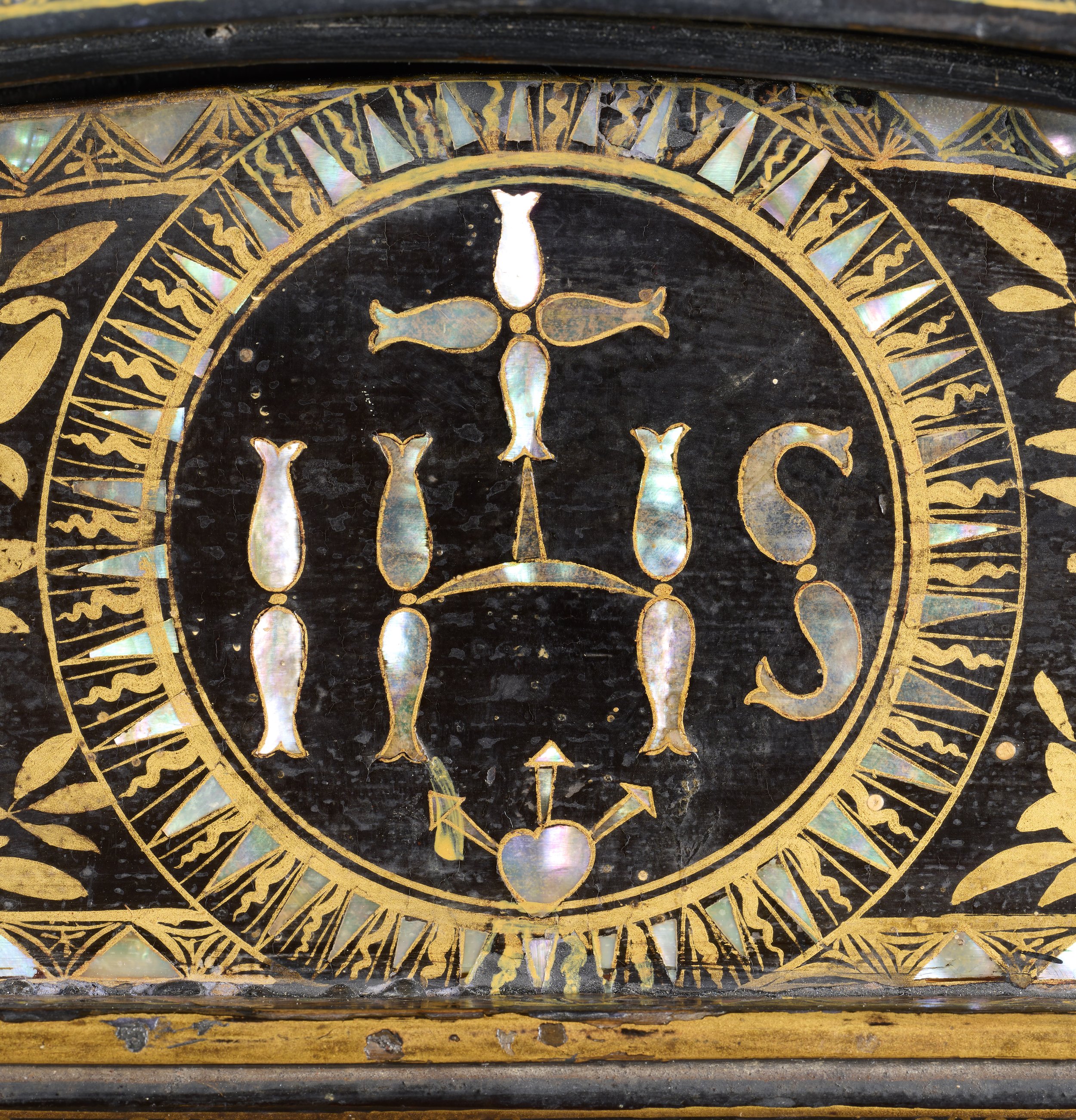
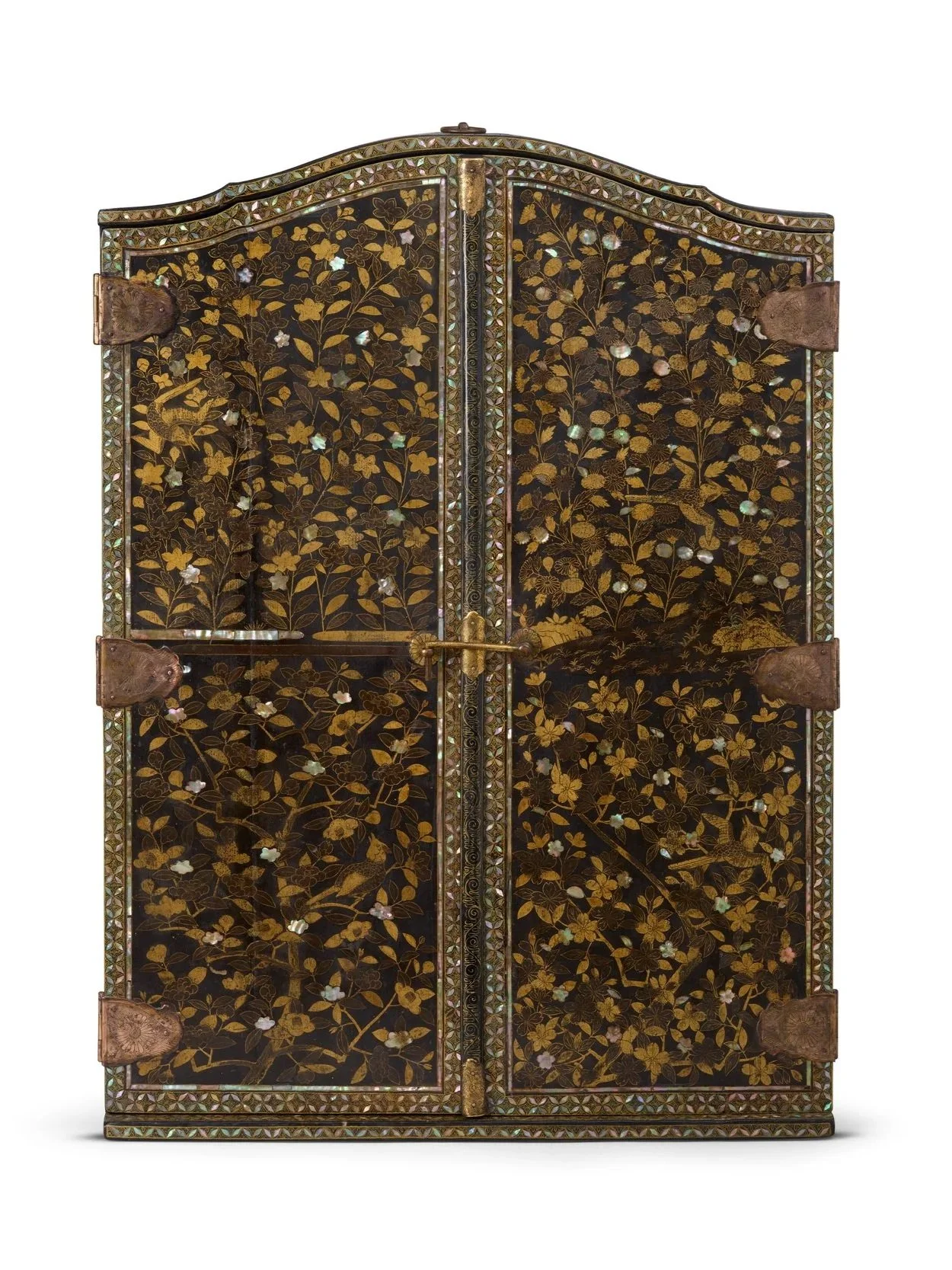
This large and rare oratory is distinguished by its two non-rectangular doors, which follow the curve of the arched pediment above—an unusual and carefully conceived design feature. The doors close over a central panel surmounted by this pediment, which encloses a European oil painting on copper depicting The Adoration of the Shepherds. To our knowledge, only one other published example of this type is known, now in the Kyushu National Museum. That piece likewise contains an oil painting on copper, probably of European origin, suggesting a similar context of production and use.
Only a small number of related shallow rectangular Namban oratories with arched pediments bearing the IHS monogram are known today. One comparable example is in the Museu do Oriente in Lisbon, where the exterior doors are decorated with birds and stylised plant motifs set within scalloped panels against a black lacquer ground.
The screen is published in Asian Lacquer: A Lasting Story of Fascination and Inspiration, 2025, pp. 290-93, no. 27.
Catalogue available for purchase at the galleries and at the TEFAF stand.
To purchase online, please fill in our contact form or email books@jorgewelsh.com