

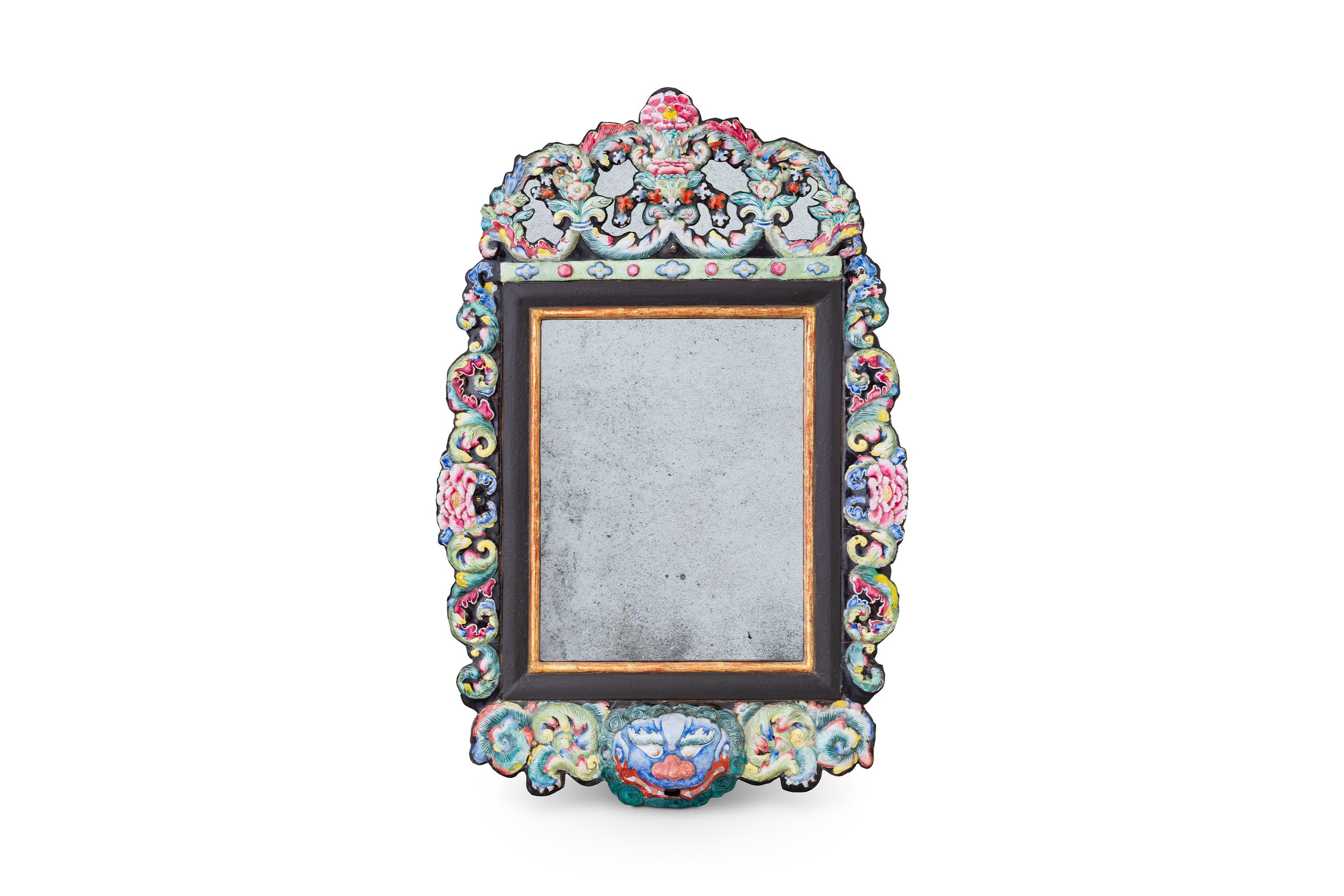
Wall Mirror
China - Copper decorated with famille rose enamels; mirrored glass; wooden support
Qing dynasty, Qianlong period (1736-1795)
H. 50 cm L. 32.5 cm W. 15.5 cm
Ref. 15342
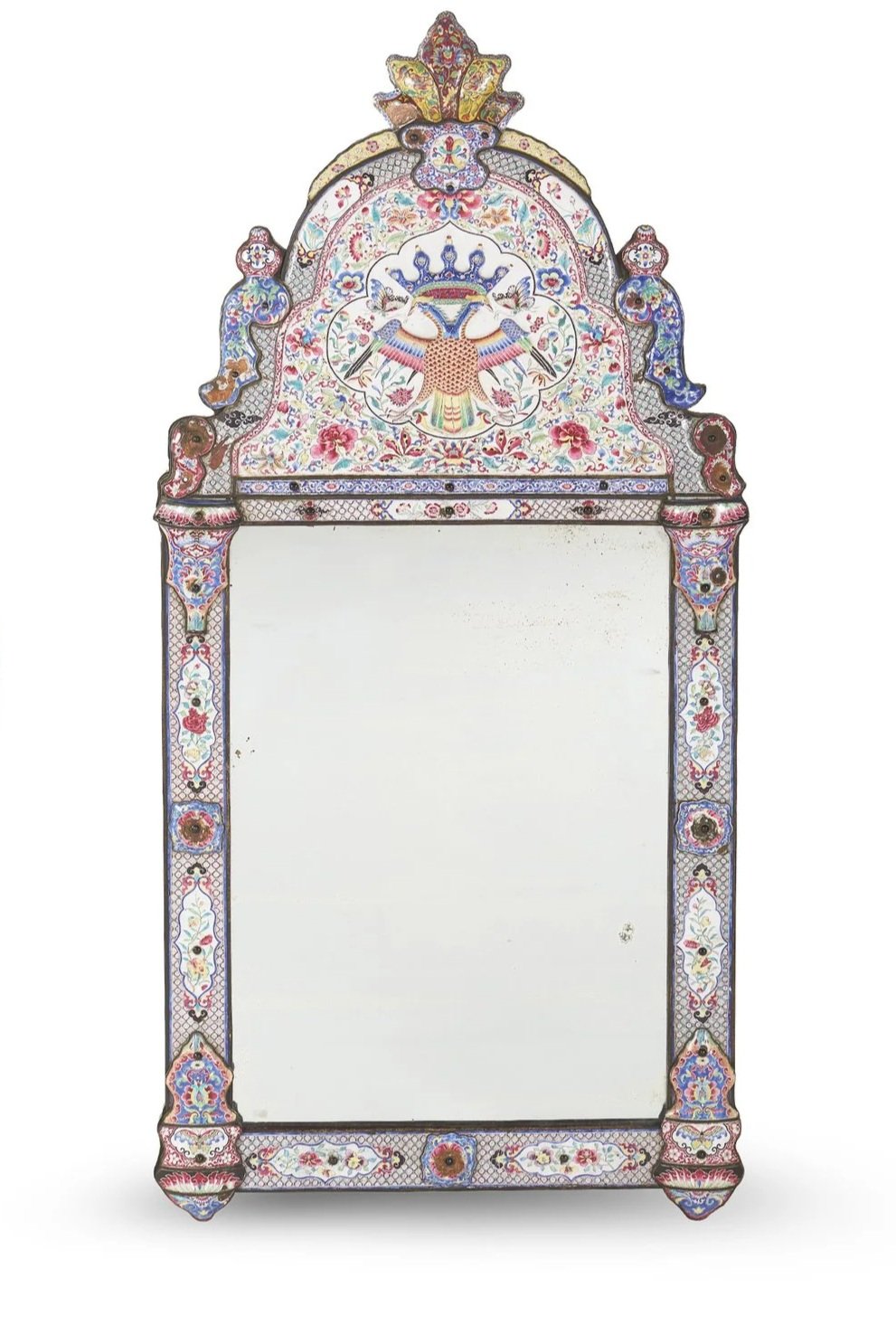
Wall Mirror
China - Copper decorated with famille rose enamels; mirrored glass; wooden support
Qing dynasty, Qianlong period (1736-1795)
H. 130 cm L. 62 cm
Provenance: Architect João Teixeira Collection
Ref. 16903
Enamels painted on copper produced in Guangzhou (Canton) during the eighteenth century formed part of a dynamic export industry that developed alongside porcelain and lacquer. Following the lifting of the maritime trade ban in the late 17th century, Guangzhou became the principal centre for foreign trade, and workshops there adapted enamel techniques—originally associated with imperial production in Beijing—to meet overseas demand.
From the Qianlong period (1736–1795) onward, objects enamelled on copper and other metals were exported to Europe, the United States and other regions, where they entered elite and aristocratic collections. These canton enamel wares were often decorated in the famille rose palette, characterised by opaque pinks, soft greens and iron-red tones.
While these works were established within Chinese ornamental traditions, they were adapted to accommodate foreign forms and heraldic devices, at times echoing European metalwork and the use of painted enamel as decorative inlay on clocks, snuffboxes and furniture, such as the Bureau. Over the late eighteenth and early nineteenth centuries, a more flexible market emerged in Guangzhou as private trade expanded and workshop names began to appear on signed enamels, indicating greater diversity in production and patronage.
Mirrors in canton enamel constitute a comparatively small and specialised group within this production. They were usually conceived as luxury furnishings rather than utilitarian objects, intended for aristocratic interior decorations in Europe. The mirrored glass is set within elaborately enamelled copper frames, sometimes further enriched with gilt-metal mounts. Decorative schemes frequently include dense floral grounds, shaped cartouches and crestings incorporating armorial bearings, reflecting the custom of commissioning personalised objects for prominent families. One of the mirrors shown above bears the emblem of the Augustinian Order: a double-headed eagle surmounted by a five-pointed coronet. Surviving examples suggest that Canton enamel mirrors were produced in limited numbers during the Qianlong period, when technical refinement and sensitivity to European taste were at their height. Their hybrid character—Chinese in technique and ornament, European in function and heraldic content—illustrates the adaptability of Canton workshops within the global trade networks of the eighteenth century.